A practical roadmap for professionals who knows that their current pace and direction isn’t sustainable, its not what they want and are quietly working out what the alternative looks like. No fantasy, no silver bullets, just an honest plan.
There is a particular kind of conversation which happens at this stage of life, usually in private, usually with someone you trust. It goes something like this: “I’ve done well. I like what I do. But I can’t keep doing it at this pace. I want more time – for my health, for my family, for the things I actually care about and I’m not sure how to get there without throwing away everything I’ve built.”
If that conversation is happening in your head or you’ve already had out loud – you’re not alone and you’re not being ungrateful. You’re being honest with yourself about something that the professional world doesn’t make it easy to say out loud: that full-time, five-days-a-week, always-on employment is not the only path that a career can take in the 2020s. The path you’ve trodden is not necessarily the path you want for the next fifteen years. We’ll say it again – this isn‘t you being ungrateful.
This is not an article about quitting your job and taking off in a restored Camper Van – although that can have it’s appeal. It’s not about passive income or becoming a digital nomad. It’s about something more specific and more realistic: a deliberate, considered transition towards working less – fewer days, fewer hours, or a whole different direction in your work – without the financial shock, the identity crisis, or the professional fallout which most people assume is inevitable.
TLG TIP
Who This Article Is For?
This roadmap is written for someone at director level or above – earning well, established in their field, with professional equity built up over decades. The strategies included here are recommended for someone in this position. They are not suitable for someone at the start of their career. This article also assumes a level of financial security and professional reputation which makes the transition possible.

Why Three Years and Why It’s The Right Horizon
The three-year horizon is not set in stone. It is long enough to make structural changes to your career and finances without either panicking or losing sight of the end goal. It is short enough to feel real and to create the urgency which makes starting to plan now justifiable – but still within reach.
Most people who want to work less make one of two mistakes. They either move too fast – making a dramatic decision in a moment of burnout or extreme stress (which they later regret) or they move too slowly, spending years meaning to do something different, never quite starting or never achieving the goal. Three years is the sweet spot: long enough to be strategic, short enough to be motivating.
Coincidentally, it is also the right length of window to achieve the practical steps. Repositioning your professional profile takes time. Having the right conversations with the right people takes time. None of it is complicated, but all of it requires lead time that most people underestimate.
Three Years…
…is the minimum time frame for a considered, financially viable reduction in working hours for someone at at director level.
Most people who successfully transition to working less say they wish they had started planning two to three years earlier than they they actually did. You need to consider that you’ll still be working whilst you’re managing this transition, so you will need to fit in around work and life.
The Five Part Roadmap
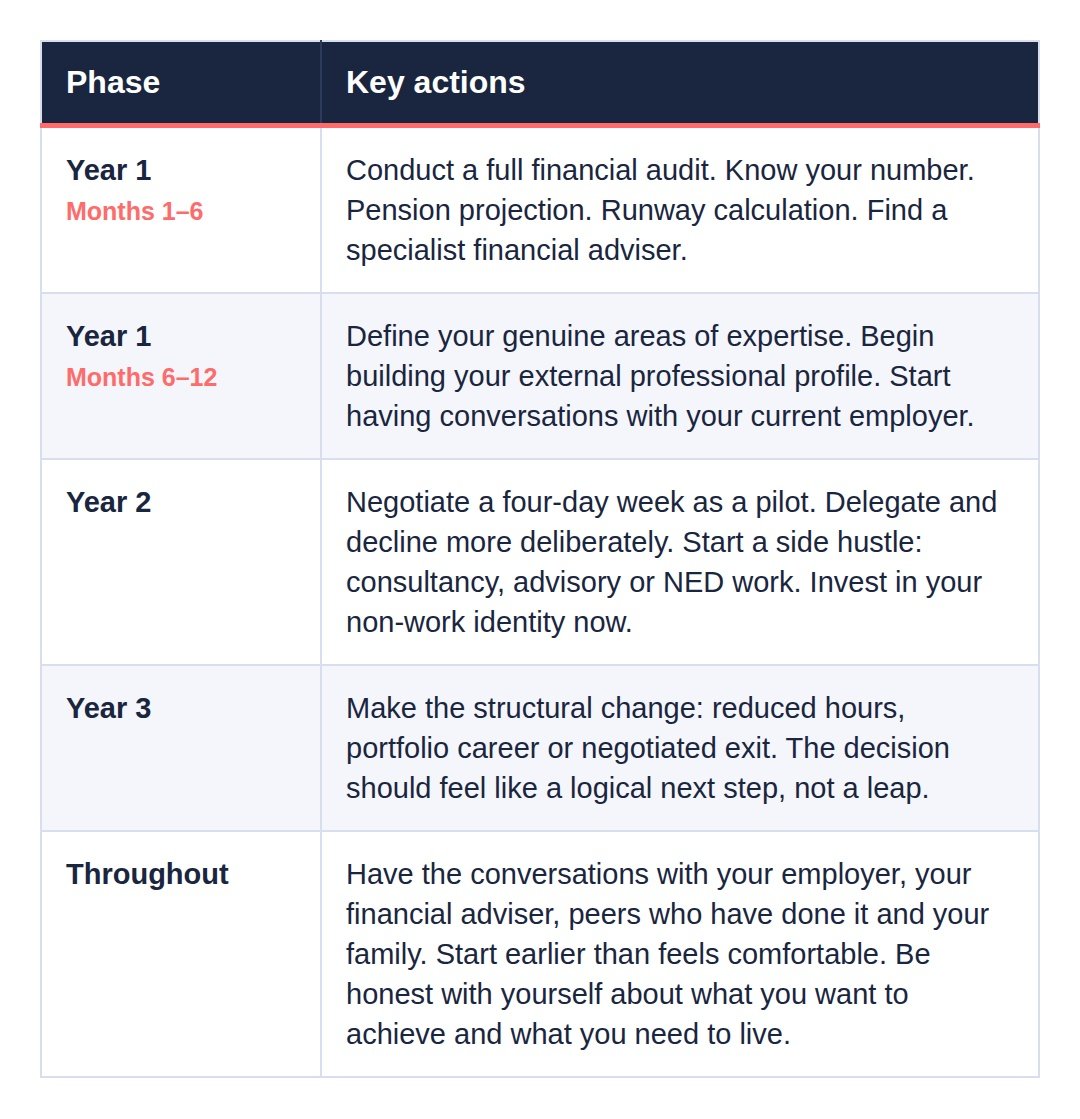
Part 1 (Year One – Months 1–6): Get Honest About Your Numbers
Everything else in this plan depends on one thing: knowing exactly where you stand financially. Not roughly. Exactly.
Most high-earning professionals in their 40s have a poor grasp of their actual financial position. They know they earn well and spend well, but haven’t considered:
- the gap between income and expenditure
- the state of their pension(s)
- investment position
AND crucially – the number they need to feel financially safe is often unclear. This is the first thing to address.
The number you need to know
What is the minimum annual income that would allow you to live the life you want, without financial stress?
- Not your current income
- Not your aspirational income.
Your minimum viable income, for the life you actually want to live.
The pension audit
At director level, your pension position is often the most important financial asset you have and the one that often receives the least active attention. Get a current projection from your pension providers (or providers if you have more than one). Understand what you’re on track for and what the gap is. The answers will significantly shape your transition timeline.
The runway calculation
How many months could you cover your minimum viable income from savings and investments alone, without touching your pension? Six months is a minimum safety net. Twelve months is comfortable. Twenty-four months gives you genuine strategic flexibility.

TLG TIP
Financial Advisers
If you don’t currently have a financial adviser who specialises in career transition planning, this is the moment to find one. A good IFA pays for themselves in clarity and confidence, particularly around pension planning, tax efficiency and the sequencing of income as you reduce your hours. Ask for a recommendation from someone who has done something similar rather than going to a generic financial planning firm.
Part 2 (Year One, Months 6–12): Build Your Professional Equity Deliberately
The single most common fear among professionals who are considering working less is that they will become less relevant. That if they step back from the pace, the visibility and the always-on availability, which got them where they are, something will be lost and can it be achieved again?
This fear is not unfounded. But it is manageable and the answer is to become more intentionally visible in the ways that matter and are relevant to the new direction, rather than trying to maintain the same level of visibility across every aspect of working life.
Identify your three or four genuine areas of expertise
Not your job title. Not your responsibilities. The things you are genuinely excellent at, that other people cannot easily replicate and that the market consistently values. This list is shorter and more specific than you may initially think.
Start building an external profile around those areas
Speaking at industry events, writing for trade publications, becoming active on LinkedIn in a structured rather than performative way – mentoring & advising. The goal is to make your expertise legible to people outside your current organisation, the people who will be your clients, your network, or your employers when you work in a different way.
Have the conversation with your current employer earlier than feels comfortable (More on this below)
But the time to start that conversation is not when you’re ready to reduce your hours. It’s twelve to eighteen months before, when you have the negotiating position of someone who is planning ahead rather than someone who has already made up their mind. At this stage there is room for negotiation and flexibility.
Part 3 (Year Two): Restructure The Work You Do Now
Year two is about making tangible changes to your current role before making any structural changes to your employment status. The goal is to test the reality of working differently and discover what the real constraints are, before committing to anything irreversible.
The four-day conversation
For most professionals, a four-day week is the most achievable first step. It is increasingly common, accepted and in most functions – involves very little actual loss of output. The research on the four-day week consistently shows that productivity either holds or improves. The conversation is easier to have than most people expect, particularly when it is framed as a pilot rather than a permanent change, especially if the person proposing it has a track record of delivery.
Protect your time, not just your diary
Reducing hours is not the same as working less if the same volume of work is compressed into fewer days. The second part of the year-two work is being more deliberate about what you agree to do, what you delegate and what you decline. This is harder than reducing your hours. It requires a willingness to disappoint people, to give up control of things you are used to owning and to accept that some things will be done differently, not necessarily worse, but by other people.
Start a side track in parallel
Whether that is consultancy work, non-executive director positions, advisory roles, board membership, or building something of your own – year two is the right time to begin exploring what working in a different format looks like in practice. Not to replace your income yet. To test your assumptions about what you want, before you commit to it.
TLG TIP
The Identity Question
This is the part that the financial planning guides miss. For many professionals, work is not just what they do – it is a significant part of who they are. The transition to working less involves an intentional identity shift which takes time and is often harder than the financial or structural elements.
The people who navigate it well are the ones who have already invested in the other parts of their identity – sport, relationships, projects, community – all before they reduce the work. Start that investment now, not when you have more time.

Part 4 (Year Three): Make The Structural Change
By year three, if the previous two years have gone well, the structural change should feel like a natural next step rather than a leap into the unknown.
- You know your numbers
- You have built your external profile
- You have tested a different way of working
- You have at least one alternative income stream, however nascent
- You have had the difficult conversations.
The structural changes available to someone at this stage typically fall into one of three categories:
Reduced hours in a continuing employment relationship
Three or four days a week – negotiated formally, with a proportional reduction in salary. This is the lowest-risk option and the right one for people who like what they do, where they work and simply want more time back. The negotiation is easier if you have spent year two delivering results, building goodwill and you are proposing a formal arrangement rather than simply announcing that you want to work less.
A portfolio career
A mix of part-time employment, consultancy, advisory and non-executive work which adds up to the income you need without any single commitment requiring a full-time commitment. This is the right model for people who have built expertise over time, who want variety, flexibility and autonomy. It requires more active management and more entrepreneurial thinking than remaining employed and it tends to take longer to establish than you’d think.
A negotiated exit with a transition period
Leaving your current employer on good terms, with a consultancy arrangement built in for the transition period, moving into independent work. This is the highest-risk option in the short term and the highest-reward in the long term. It works best for those who have a clear sense of what they want to do independently and at least one – two clients/projects already lined up before they leave.
Throughout: The Conversations You Need To Have
The most important thing you can do in the three-year transition is to have the conversations most professionals avoid until it is too late – no matter how difficult and awkward it feels. Not dramatic announcements – honest, ongoing conversations with the people whose decisions shape your professional future.
- With your current employer: not “I want to leave” but “I want to work differently – what would that look like here?” The answer will tell you whether the transition can happen within your current company or has to happen outside it.
- With your financial adviser: not “When can I retire?” but “What is the minimum income I need and what are the different ways I could generate it?”
- With your peers who have done it already: the most useful information about working less at director level comes from people who have already navigated the transition, not from articles or books. Find three people who have done something similar to what you want to do and invite them for a coffee.
- With your partner or family: the transition affects more than your professional life. The financial adjustments, the change in routine, the identity shift – these have implications at home which are much easier to navigate if they are discussed openly in advance.

The Four Most Common Mistakes
Moving too fast after a bad period
Burnout is a terrible strategic adviser. The impulse to make a dramatic change after a bad quarter, a difficult restructure, or a health scare is completly understandable, but often leads to decisions which can feel wrong down the line. Use those moments as the reason to start the three-year plan – not to make an impulsive move.
Underestimating the income you actually need
Most people planning to work less underestimate their baseline expenditure – particularly based on things they currently expense or cover through work-related benefits: pension contributions, private health insurance, company car, phone and the general financial ease of a senior salary. Build a detailed picture of your actual costs before you make any decisions.
Failing to maintain professional relationships during the transition
The professional network you have built over twenty years is your most valuable asset in a portfolio career or independent consultancy. The biggest mistake professionals make when they reduce their hours is becoming less visible at precisely the moment when visibility matters most. Counter-intuitive but true: the transition period requires more intentional networking, not less.
Waiting until everything is perfect
There will never be a perfect time. The financial cushion will never be quite enough. The timing will never be quite right. The company you work for will never be quite ready. The people who successfully work less are the ones who start the process before they feel ready, because the process itself creates the conditions for the change. Waiting for certainty is a reliable way to not change anything.
What success looks like
The professionals who navigate this transition well – who are actually working less in three years without the financial damage or the career implosion will share a few characteristics of note.
They started planning earlier than they felt really necessary. They were more honest about their finances than they felt comfortable. They had the difficult professional conversations before they felt ready to. They invested in the other parts of their life – health, relationships, interests – before they had the time, not after. They accepted that the transition would take longer and be more uncertain than they initially expected.
None of this is easy. But that’s not to say it‘s not achievable. The transition to working less at is a project and it responds to the same disciplines which have served you well already in your career: clear goals, honest assessment of where you are now, a realistic timeline and consistency over time.
The only thing that makes it different from those other projects is that this one is about the life you actually want to be living. Which, as motivating factors go, is not a bad one.
The Bottom Line
The goal is not to stop working. It is to stop working in the way that isn’t currently working for you. There is a version of the next fifteen years where you do work in a way that you find meaningful, at a pace that allows you to be healthy and present, with the financial security that your career has earned you. It exists. It is achievable. It starts with a plan, not a crisis.
Three years. Start now.
The Longer Game