
Move More. Hurt Less. Keep Going.
Somewhere in your 40s, the equation changes. The sports you used to play without a second thought starts to cost you. The knees you ignored for twenty years start to make themselves heard and felt. The Monday-morning gym sessions that felt heroic start to feel like something you need to recover from.
Yet you still want to move. You’re not ready to swap sport for gentle walks and the occasional swim. You just need to think smarter.
That’s what this area is about. Movement that fits your body now. Sport that’s sustainable over decades, not just months. Fitness advice that starts from where you actually are, not where you were when you were 28.
Padel - our launch sport
Why We Started With Padel
Padel is the fastest-growing sport in Europe. In the UK, the number of courts has now reached more than 600 in under three years. If you look at who’s playing it – really look – it’s people in their late 30s to 60s – just like us.
It’s not a coincidence. Padel is played on a smaller court, mainly as doubles, with an underarm serve. It’s social, it’s relatively easy to learn and it is so much kinder to your joints than the racket sports most of us grew up playing. If you gave up squash because of your knees, or you find tennis too physically demanding to play consistently nowadays, padel might be the answer you didn’t know you were looking for.
We launched The Longer Game with padel because it perfectly represents what this community is about: a sport that becomes more enjoyable as you get older, which you can play with friends, which doesn’t require you to be an athlete and that has an enormous amount of room for growth and improvement at any level.
“I quit squash at 45 because of my knees. Three months later, I was playing padel three times a week and feeling better than I had in years.”
“It’s social – probably because it’s mainly played as a four – I’m already addicted.”
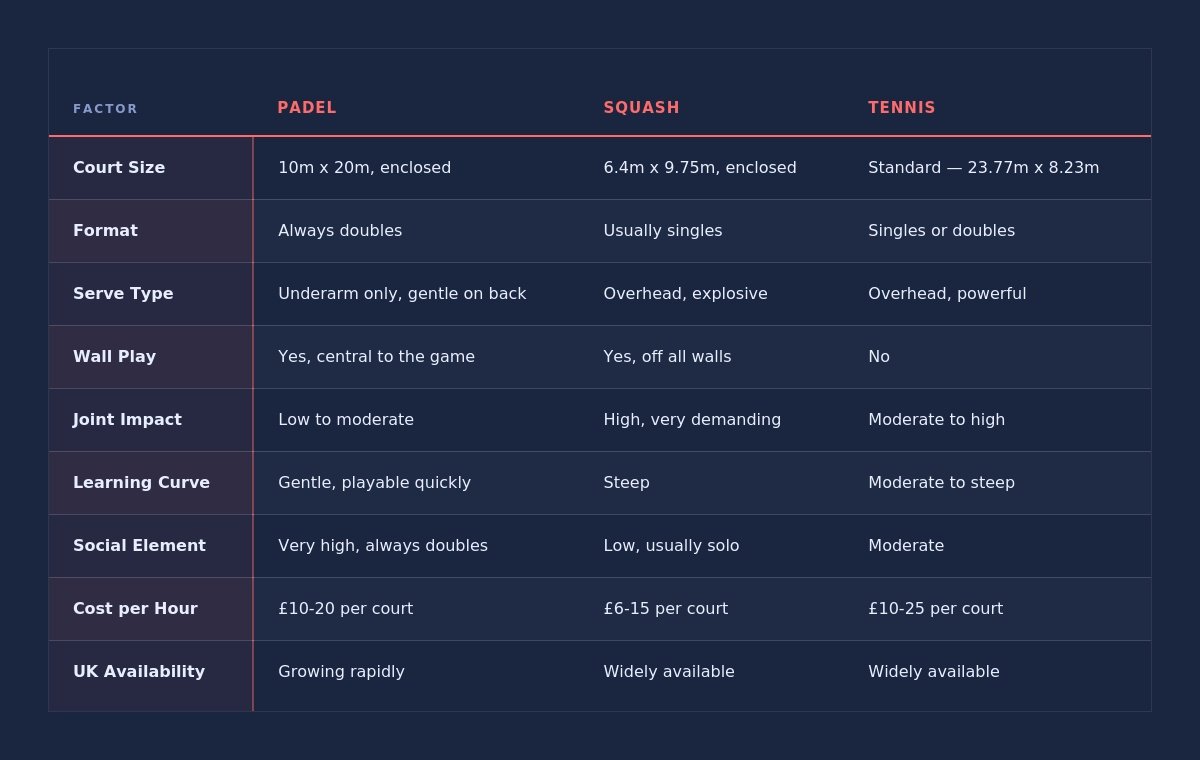
PADEL VS OTHER RACKET SPORTS - COMPARISON
Padel Vs Squash Vs Tennis - The Full Picture
If you’ve played racket sports before, here’s how padel compares on the things that matter most at this life stage
WHY PADEL IS EASIER ON JOINTS:
The Joint Health Argument - Why It Actually Stacks Up
This isn't marketing. There are genuine biomechanical reasons why padel is kinder on the 40-plus body than squash or singles tennis and it's worth understanding them.
Court Movement and Impact Forces
Squash involves repeated explosive sprints, sudden stops and full-court lunging - some of the highest-impact movement patterns in recreational sport. Padel's enclosed court and wall play naturally slows the game down and reduces the frequency of explosive directional changes. You move plenty, but you're rarely lunging from one end of the court to the other.
The Serve
The padel serve is underarm. End of. No hyperextension the lower back, no overhead shoulder stress, no wrist snap. For anyone who has developed tennis elbow, a dodgy shoulder, or chronic lower back issues - this makes a huge difference.
The Doubles Format
Padel is almost always played as doubles. That halves the court coverage per player compared to squash singles. Less court to cover means less cumulative stress per session - which means you can play more frequently without the exended recovery period.
Racket Design
Padel rackets are solid, short and compact. Swings are shorter and more controlled than in tennis or squash, reducing the repetitive stress on elbows, wrists and forearms. If you've suffered from tennis elbow or golfer's elbow, you’ll know what we‘re talking about and will feel the difference immediately.

GETTING STARTED - PRACTICAL GUIDES
Everything You Need to get on Court
We've created a range of guides and articles - so you don't have to figure it all out from scratch. Here's where to start:
The Complete Beginner's Guide to Padel in the UK (2026)
Rules, courts, kit, etiquette and what to expect from your first session. The only guide you need before you pick up a racket. Download the free PDF and read at your leisure.
Best Padel Rackets for Beginners UK
We’ve looked at the beginners rackets available in the UK and have ranked them on weight, balance, sweet spot size and value. The right racket protects your elbow and improves your game.
Read Now
Which Padel shoes Do You Actually Need?
Yes, shoes matter. Non-marking court shoes give you the grip and lateral support that running trainers don’t. We’ve tested across price points and picked the best for different budgets.
Read Now
How to Find a Padel Court Near You
There are now over 600 padel courts in the UK and more opening every month. Here’s how to find courts in your area, what to expect when you book and apps to make booking easier.
The Best Padel Balls in 2026
Indoor courts offer year-round play and a more consistent surface. Outdoor courts are cheaper and more casual. Both have their place and the choice affects what kit you’ll need.
Read Now
FLEXIBLE WORKING
How to Work Less in Three Years. A Practical Framework
Know your number
Determine your baseline income by calculating the actual cost of your lifestyle. Many find this number drops significantly once work-related expenses like commuting and convenience spending are removed.
Build the bridge
Create a financial buffer through savings, redundancy payments, or a phased transition. A deliberate “bridge” provides the stability and choices needed to move into independent work on your own terms.
Start before you leave
Don’t wait until you’ve quit to build your independent future. Expand your network and establish your reputation while still employed to ensure momentum the moment you make the move.
Latest
Articles
Indoor Vs Outdoor Padel UK: Which Is Right For You?
Indoor courts give you consistent conditions all year. Outdoor courts are more accessible and cheaper to book. The right answer depends on when you play, what you wear and how seriously you want to take it.
I Quit Squash at 45 Because of my Knees – Why I Started Padel
A personal account of swapping a sport I loved for the one that loves my body back and why this might be the most important sporting decision I've made in twenty years.
How to Work Less in Three Years Without Blowing Up Your Career.
A practical roadmap for professionals who know the current pace and direction isn’t sustainable and is quietly working out what the alternative looks like. No fantasy, no silver bullets, just an honest plan.