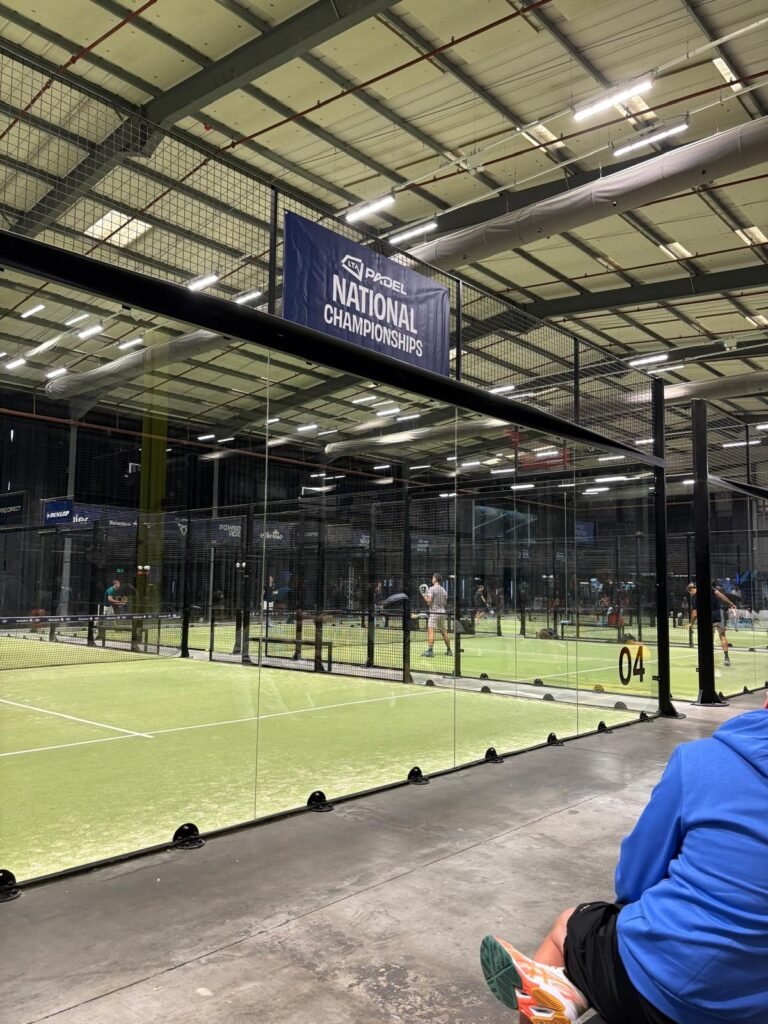
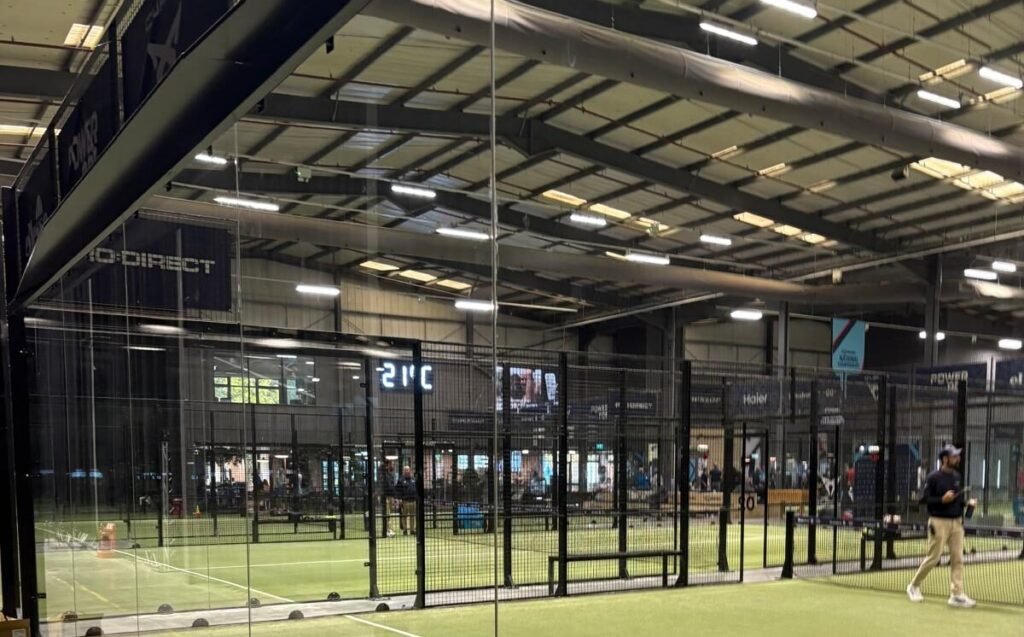
Indoor courts give you consistent conditions all year. Outdoor courts are more accessible and cheaper to book. The right answer depends on when you play, what you wear and how seriously you want to take it.
The Key Differences at a Glance
A quick reference across the factors which matter most for those who play regularly.
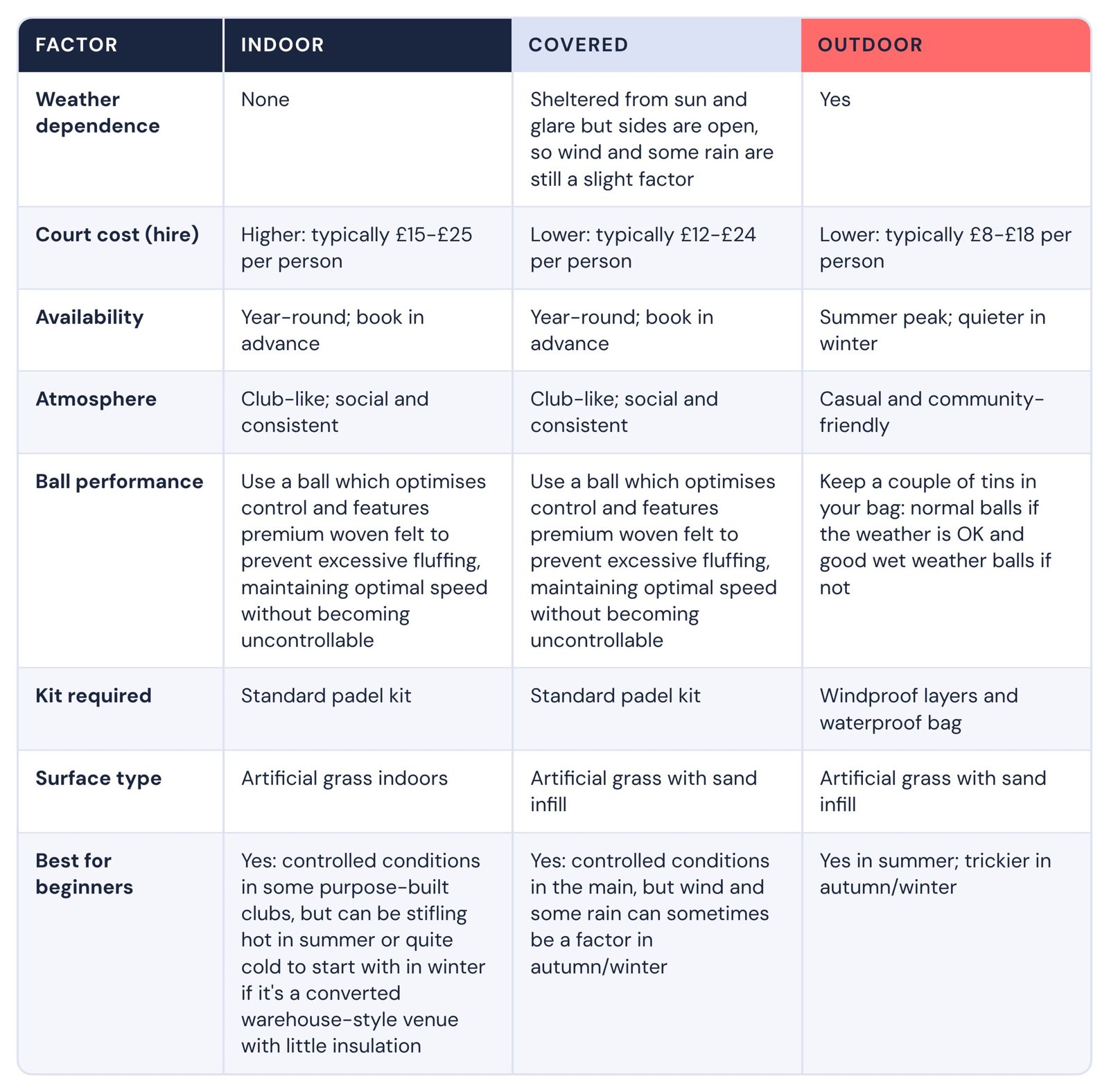
Padel is now widely available across the UK. There are outdoor clubs at tennis clubs, leisure centres and community facilities. Padel courts are also fully indoor or covered – not fully indoor, but with a covering which protects from rain. These are generally in purpose-built structures or converted from industrial warehouses or farm buildings. For anyone picking up the sport for the first time or looking to play more regularly, the choice between the different options affects your costs, your kit and how often you actually make it onto a court.
This article covers what each format offers, costs and what you need to get the most from your game. If you are just starting to play padel, download The FREE Beginner’s Guide to Padel in the UK for the full picture on courts, kit and rules.
Cost can be the key factor – membership of a tennis club with padel courts can cost around £35 a month for unlimited play versus £30 for just 1 game at an indoor club. Most people who enjoy and really get into padel will be a member of an outdoor club – but have an indoor Plan B if the weather is bad.
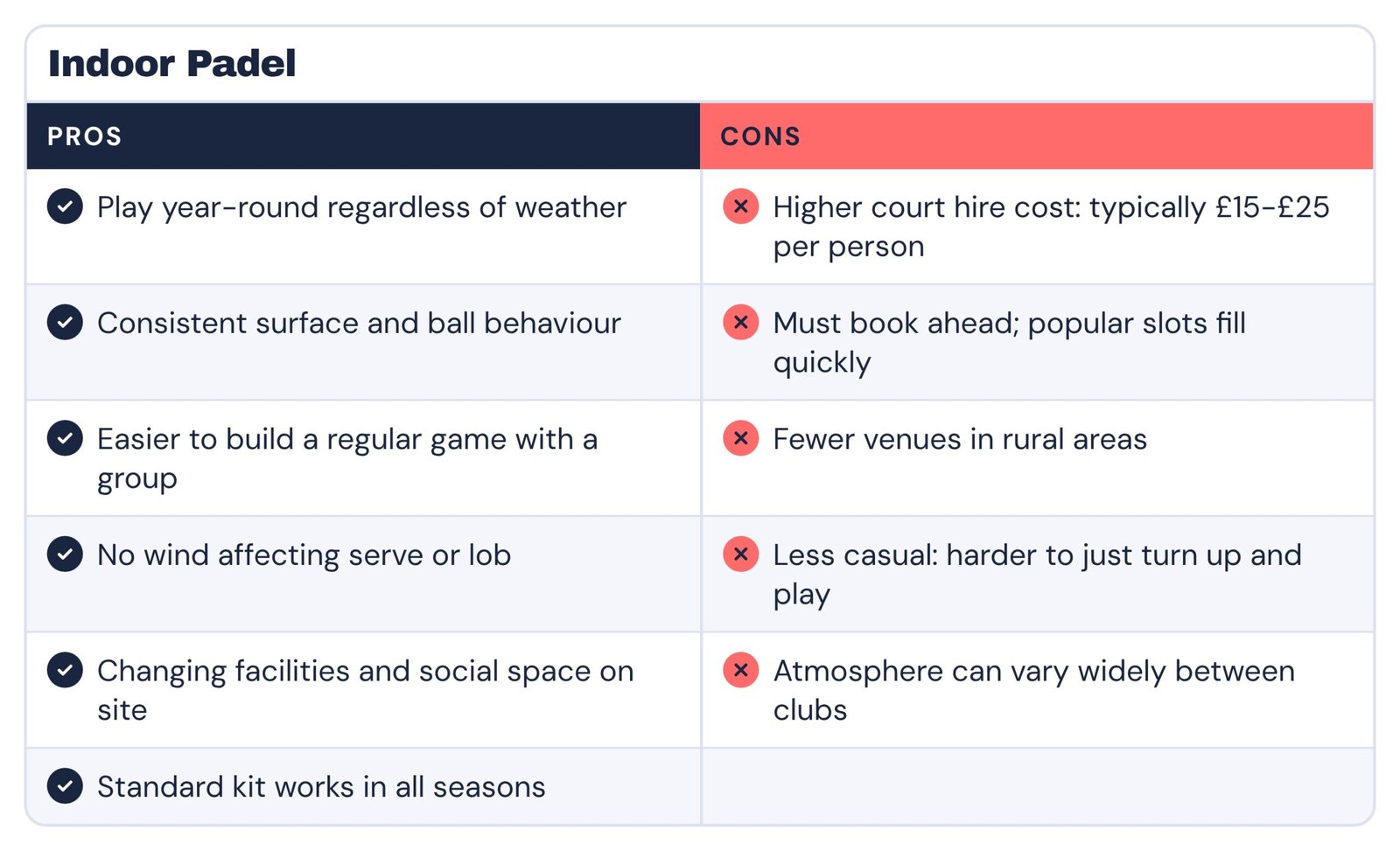
Indoor Padel: The Case For Playing Indoors
Indoor padel clubs have expanded quickly across the UK over the last three years. Most are purpose-built with four to eight courts under a single roof, a reception area, changing facilities and a bar or cafe. The playing experience is consistent session to session: same surface, same temperature, same light. You book in advance and you know exactly what to expect.
For players in their 40s, 50s and 60s who want to play regularly and build a consistent game, indoor clubs are the easier environment to improve in. There are no weather variables to blame and the community tends to be consistent because the same players book the same slots week after week.
Outdoor Padel: Fresh Air, Lower Costs and A Different Game
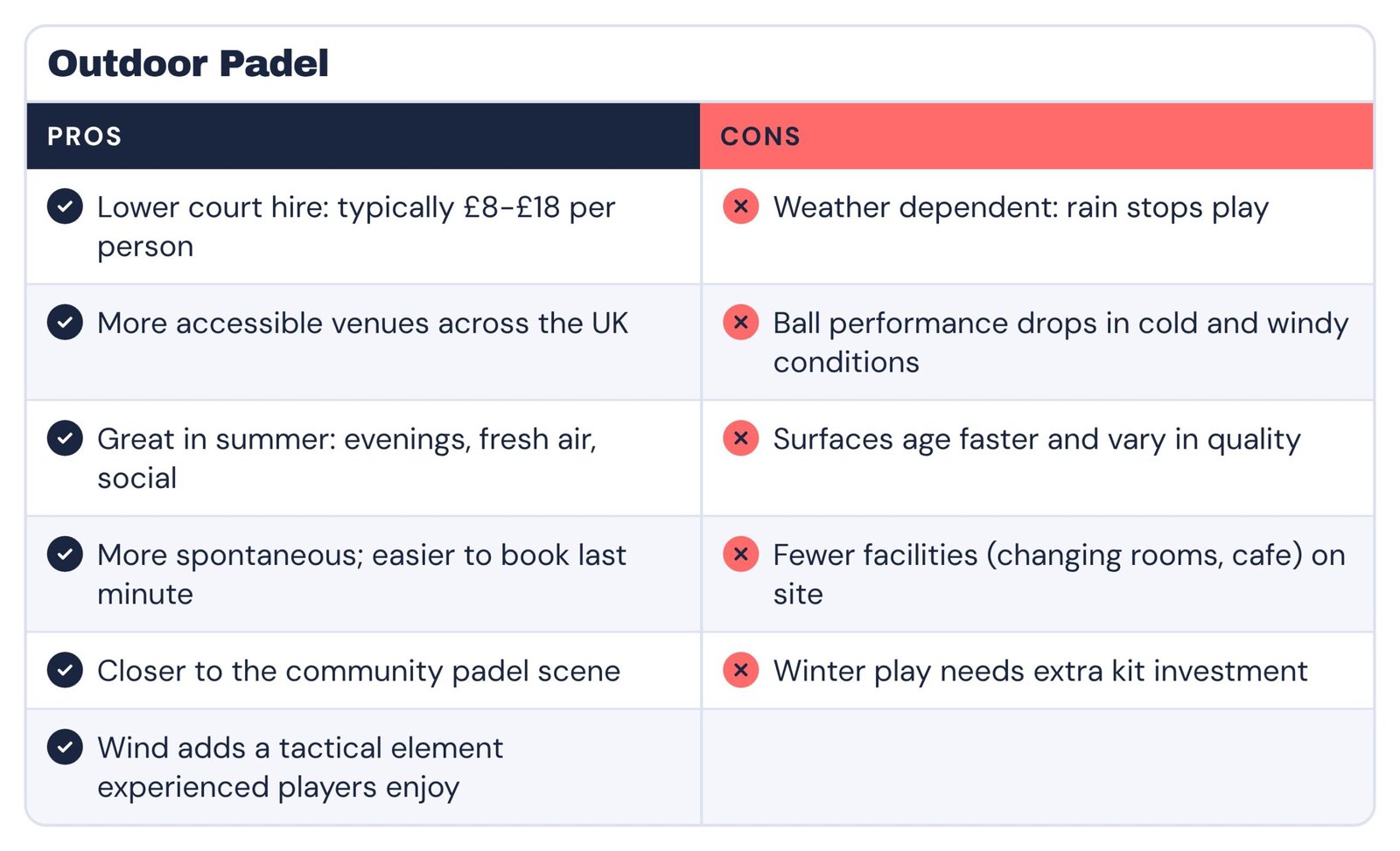
Outdoor padel courts have been part of the UK landscape far longer than indoor clubs. Many tennis clubs converted one or two courts to padel in the early 2020s. Community leisure centres followed. The result is a more scattered, but often more affordable network of courts, particularly outside major cities.
The game plays differently outside. Wind affects the ball flight and lob depth. In cooler months, standard balls lose pressure and bounce lower. The surface tends to age faster without the shelter of a building. None of this makes outdoor padel worse; it just makes it different. Many experienced players actually prefer the outdoor game for its unpredictability and the fact that it rewards reading conditions as much as technique.
Summer outdoor padel in the UK is genuinely excellent. The season from May through September gives you long evenings, good court conditions and a social game that feels more accessible than a booked club session. It is also where most new players start.
Padel in Winter: Can You Play Outside?
Yes. Most outdoor courts stay open through winter and many dedicated players prefer it. The practical considerations are manageable with the right prep upfront.
The main issue is ball performance. Standard padel balls are pressurised for temperatures around 20 degrees celsius. Below 10 degrees, the pressure drops and the ball bounce becomes lower and less consistent. Switching to pressurised outdoor balls designed for cooler conditions makes a real difference to how the game plays. More on this below.
The second issue is comfort. Standing around between points in a November wind on a hard surface will take you off court faster than any physical overeffort. A windproof mid-layer worn over your base layer and under a light padel jacket covers most UK winter conditions. Gloves are worth trying; the initial awkwardness on the grip fades after a few minutes.
A waterproof bag to protect rackets from rain and damp is also worth investing in if you play outdoors regularly. Padel racket cores are sensitive to moisture and a wet bag left in the boot of a car after a session will shorten a racket’s life considerably.
TLG TIP
GEAR FOR OUTDOOR WINTER PLAY
Windproof mid-layer: look for padel or tennis-specific designs with a stretch panel across the back.
Outdoor padel balls: pressurised cans rated for cool conditions. A sleeve of three lasts roughly two outdoor sessions.
Waterproof racket bag: a simple padded cover or a full padel bag with a waterproof lining both work.
Padel gloves: optional but useful in temperatures below 8 degrees Celsius.
THE SCIENCE IN SHORT
Padel’s enclosed court, underarm serve, doubles format and shorter swing mechanics combine to reduce the frequency and intensity of high-impact joint loading compared to squash – while still delivering a cardiovascular and competitive workout. For anyone who has found that their body has started pushing back against high-impact racket sports, this distinction makes a huge difference.
What to Wear For Outdoor Padel
Outdoor padel kit does not need to be expensive or padel-specific to work well. The principles are the same as any outdoor racket sport: layers you can remove, materials which that move with you and protection from wind rather than just cold.
- Base layer: a moisture-wicking top in any breathable synthetic fabric. Avoid cotton which holds sweat and gets cold quickly.
- Mid-layer: a lightweight windproof jacket or gilet. Padel and tennis brands make versions cut for overhead movement; general outdoor sportswear works just as well.
- Leggings or tracksuit bottoms: for autumn and winter play. Running tights work well and allow full movement without bulk.
- Padel shoes: the surface-specific sole is the one non-negotiable. Everything else can be substituted; footwear on the wrong surface affects both performance and joint safety.
- Bag: a padel bag or tennis bag with a padded racket section and ideally a waterproof base or cover.
In summer, standard padel shorts or skirts/skort and a breathable top cover everything you need outdoors. The layering questions only become relevant from October onwards.
Watch Out for our Kit For All Seasons Article – Sign Up for Our Newsletter to get it straight to your inbox.
Choosing The Right Ball For Outdoor Play
Standard padel balls work fine outdoors in warm weather. The issue is ambient temperature. Padel balls use internal pressure to create their bounce and that pressure falls as the air cools. A ball which bounces correctly at 20 degrees Celsius will bounce noticeably lower at 10 degrees and feel almost dead below 5 degrees.
Outdoor or all-weather padel balls are pressurised slightly higher to compensate. They play closer to a normal ball in cool conditions and are worth the marginal extra cost if you are playing from October – March. Brands including Head, Wilson and Bullpadel all make outdoor-rated balls; look for ‘outdoor’ or ‘all conditions’ on the tin.
One sleeve of three balls typically lasts two to three outdoor sessions before the pressure drops enough to affect play. Indoor balls in a climate-controlled environment last longer. If you are playing twice a week outdoors through winter, budgeting for roughly two sleeves a month covers most players.
Read Our Article On the Best Padel Balls – Our Recommendations based on your level of playing experience.
Choosing The Right Ball For Outdoor Play

Standard padel balls work fine outdoors in warm weather. The issue is ambient temperature. Padel balls use internal pressure to create their bounce and that pressure falls as the air cools. A ball which bounces correctly at 20 degrees Celsius will bounce noticeably lower at 10 degrees and feel almost dead below 5 degrees.
Outdoor or all-weather padel balls are pressurised slightly higher to compensate. They play closer to a normal ball in cool conditions and are worth the marginal extra cost if you are playing from October – March. Brands including Head, Wilson and Bullpadel all make outdoor-rated balls; look for ‘outdoor’ or ‘all conditions’ on the tin.
One sleeve of three balls typically lasts two to three outdoor sessions before the pressure drops enough to affect play. Indoor balls in a climate-controlled environment last longer. If you are playing twice a week outdoors through winter, budgeting for roughly two sleeves a month covers most players.
Read Our Article On the Best Padel Balls – Our Recommendations based on your level of playing experience.
How to Find and Book a Court
Court availability and booking varies widely across the UK depending on where you are. The most reliable starting points:
- LTA court finder: registered padel venues across England and Wales. Includes both indoor clubs and outdoor courts.
- Playtomic: the most widely used padel booking app in the UK. Covers most purpose-built indoor clubs and a growing number of outdoor venues. Shows real-time availability and allows instant booking.
- Padel Mates: UK-focused app with a useful ‘find a game’ feature that matches individual players with open slots. Good for players who do not always have a full four to call on.
- Club websites: many independent clubs, particularly newer purpose-built venues, handle bookings directly through their own site or app rather than through third-party platforms.
Outdoor court costs typically run from £8 to £15 per person per session.
Indoor clubs usually charge £15 to £25 per person for a 90-minute slot. Peak evening slots go faster; booking 48 to 72 hours ahead covers most situations at well-run venues.
TLG TIP
AUTUMN/WINTER PLAY
At this time of year if you can play flexibly, you can still get a good outdoor game before it get too cold.
Find a court near you, grab a racket and get on a court. The Longer Game’s Free Beginner’s Guide to Padel in the UK covers everything you need to know before your first session.
Frequently Asked Question
Q: Is outdoor padel playable in the UK winter?
Yes, with the right preparation. A windproof mid-layer, gloves and pressurised outdoor balls make a meaningful difference. Most outdoor courts stay open through winter. Below about 10 degrees Celsius standard balls lose pressure and bounce irregularly, so switching to outdoor balls matters.
Q: Are indoor padel courts more expensive than outdoor?
Generally yes. Indoor court hire typically runs PS15 to PS25 per person. Outdoor courts tend to come in at PS8 to PS15 per person. The gap reflects the cost of the indoor facility rather than a difference in the game itself.
Q: Do I need different balls for outdoor padel?
In warmer months, standard padel balls work fine outdoors. In cooler weather, roughly October through to March in the UK, pressurised outdoor balls hold their bounce far better in the cold and perform more consistently in wind.
Q: Which is better for beginners: indoor or outdoor padel?
Both work well for beginners. Indoor courts give you consistent conditions with no weather variables, which can help early on. Outdoor courts in summer are equally accessible and often more affordable for casual first sessions.
Q: How do I find padel courts near me in the UK?
The LTA court finder at lta.org.uk lists registered padel venues across England and Wales. Dedicated booking apps including Playtomic and Padel Mates also list both indoor and outdoor courts with real-time availability.
FREE GUIDE — DOWNLOAD NOW
The Beginner’s Guide to Padel in the UK — courts, kit, rules and why everyone over 40 is talking about it.
Download Now