

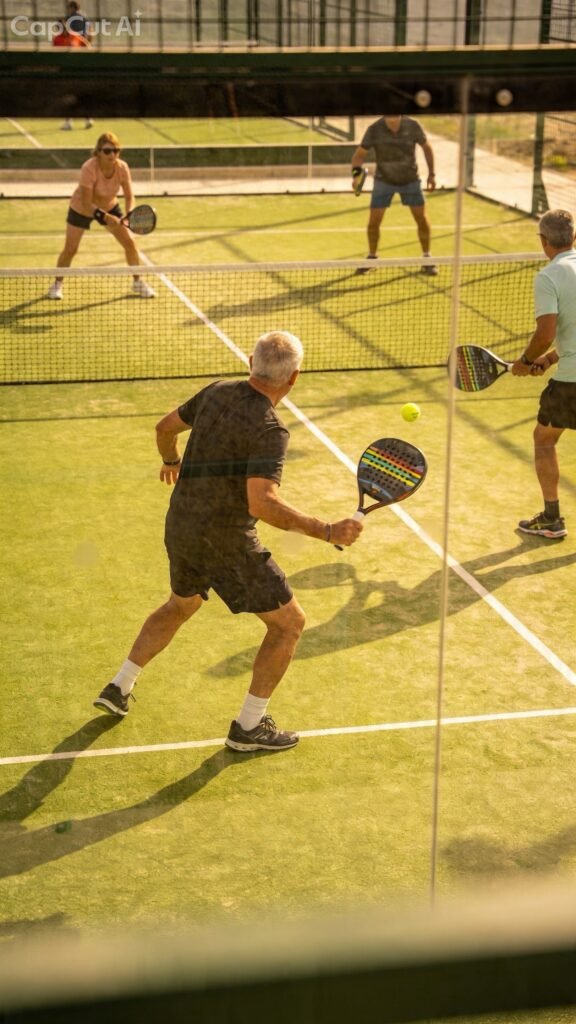
A personal account of swapping a sport I loved for one that loves my body back and why this might be the most important sporting decision I’ve made in twenty years.
KEY TAKEAWAYS
→ I gave up squash at 45 because of my knees. Padel let me play competitive racket sport again without the pain
→ Padel is easier on the joints than squash thanks to the underarm serve, mainly doubles format, enclosed glass walls and a short, stringless racket swing
→ It is still a real workout: playing twice a week noticeably improved my fitness within a short time period
→ Getting started in the UK is easy: most clubs rent rackets and court hire is around £10 to £30 an hour.
→ If a sport is starting to hurt, act on what your body is telling you early rather than playing through the pain
Background
I played squash from my teens until I was 45. Three times a week at most, once a week towards the end and then not at all. Not because I’d lost interest. Not because life got too busy. Because my knees had simply had enough.
The first sign was the left knee grinding walking upstairs. Then the right knee started aching for two days after a hard match. Then the chiropractor appointment where she explained, without quite saying it, that squash and my joints had reached the end a beneficial working relationship.
I missed it more than I expected and definitely more than I let on. Not just the sport – the ritual of it. Packing my bag for a game. Team matches. The competitiveness. A drink in the bar afterwards, when you’d relive every good and bad rally. Squash had been a constant for three decades. Before marriage – before children. Losing it felt – a little melodramatically, like losing part of myself.
“I was looking for something that fit my body now at 45, not as it was at 25. I just didn’t know it at the time”
I wasn’t looking for a replacement hobby which ticked a wellness box. I was looking for something I could compete in again – on a level playing field. Something with the same social side, two or four people on a court, a score to chase, a reason to get better. Something that fit my body as it actually is at 45, not as it was at 25.
I tried road cycling, bought the bike, the Lycra & the clippy shoes, but it just didn’t get me like squash had.
I found padel by accident, COVID closed the squash courts and outdoor padel courts started popping up. I assumed it was just tennis with walls. I was wrong.
What Actually Happens to Your Body Playing Squash After 40?
Before I explain why padel works for me, it’s worth being honest about why squash stopped working. I don’t think I’m unusual, I think this happens to a lot of people in their mid-forties and the culture around squash doesn’t always acknowledge it.
Squash is an extraordinary cardiovascular workout. The problem is the specific demands it places on your joints to deliver that workout. The court is small, but the game demands explosive, full-body movements:
- deep lunges to retrieve a ball at the back of the court
- sudden stops and direction changes which load the knee joints hard
- a overhead serving and swing pattern that can accumulate strain in the wrist, elbow and lower back over years, built up game after game.
At 25, you recover overnight. At 35, you feel it the next morning. At 45, you feel it for three days and the cumulative load means the joint inflammation doesn’t fully clear before the next game adds to it. Eventually, something stops working.
None of this means squash is a bad sport. It means your 45-year-old body isn’t the same as your 25-year-old body and pretending otherwise is a regular appointment with your friendly to the chiropractor.
My First Padel Session: Confused, Sweaty, Surprisingly Encouraged
I turned up to my first padel session with almost no preparation. I’d watched a couple of games before committing to play, which gave me the approximate shape of the rules and precisely no useful technique. But I’d played racket sports for most of my life. So I thought I’d be able to hold my own at least. My playing partner was similarly uninitiated.
We were lucky enough to pay with a padel coach, so we were offered some pointers straight away. This really helped, not because the rules are complex, but the balls behave slightly differently, the racket is different and to a spectator it’s quite easy to pick out a tennis or squash player when then first try padel.
By the end of the first hour, three things were obvious.
First: I wasn’t going to be terrible at this as much as I’d thought. The wall play is genuinely different from anything in tennis or squash. Letting the ball come off the back glass and playing it out again is just like squash, but that’s where the similarities end.
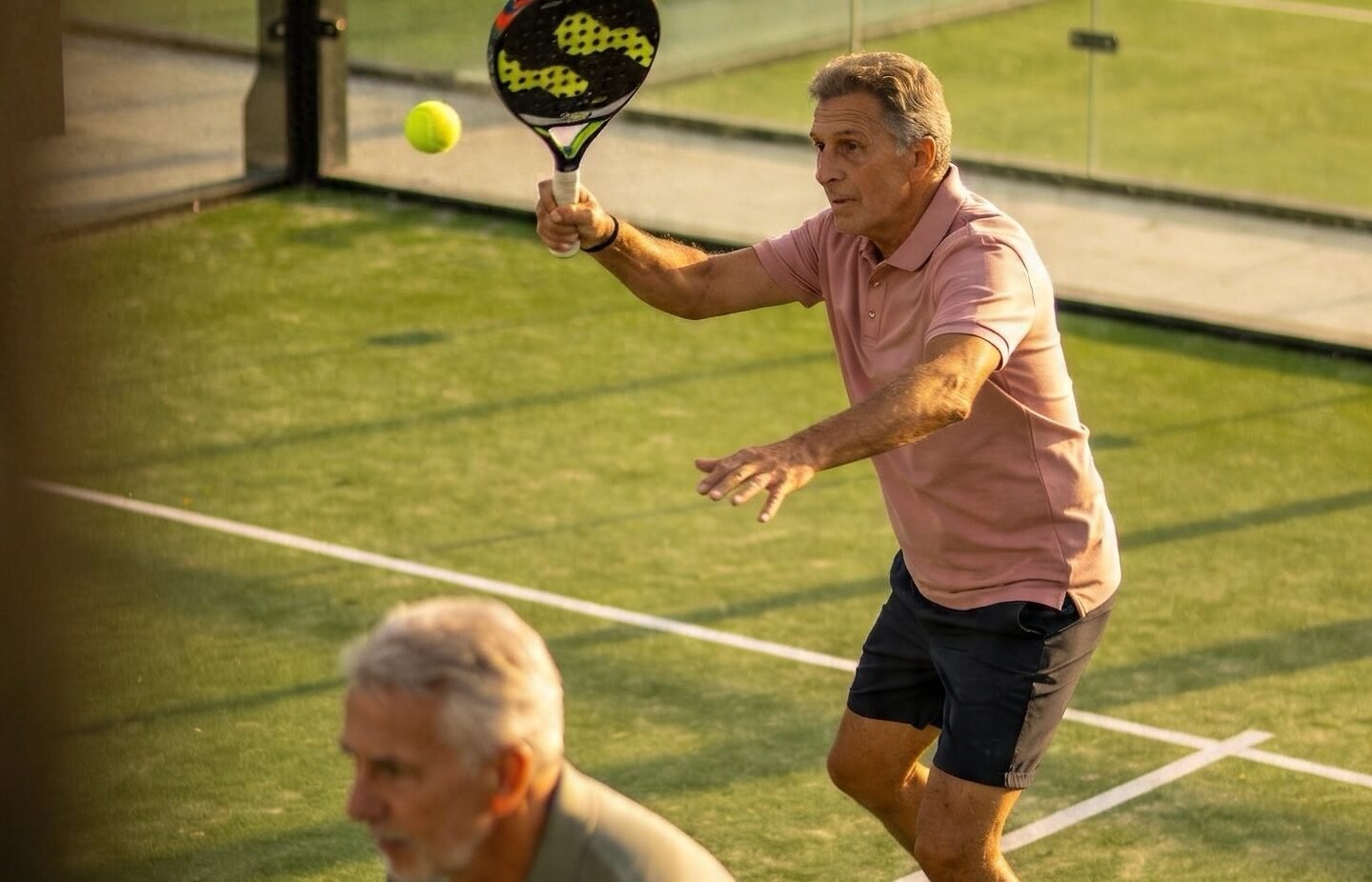
TLG Tip
A coach early on can really help you to progress and helps you to not develop bad habits.
“My knees felt fine. Not tolerable – actually fine.”
Second: my knees felt fine. Not tolerable – actually fine. The court is smaller than a squash court. The pace of the game, thanks to the enclosed glass walls, is more controlled. The rally patterns don’t require the same explosive lunges. I played for a full hour and walked out without any niggling aches.
Third: it was really fun. Not “this is good for me” fun. Actual – competitively, laugh-out-loud enjoyable. The doubles format means you’re social throughout. The glass walls create moments of exhilaration when you first start out, because you’ve kept the ball in play. Most importantly – because everyone around us was also learning, there was none of the judgment you can sometimes feel joining a new racket sport as an adult.
Why Padel Is Easier on Your Joints – The Specifics
After a few months of playing, I got curious about why my joints were responding so differently. I did some research and spoke to a sports physio – he’d seen an increase in padel players in his clinic – not with injuries, but players proactively asking whether the sport was safe given previous joint issues. What she explained made sense of my own experience.
The court size and movement patterns
- A padel court is 10m x 20m – similar in length to a squash court but wider and most importantly enclosed
- The wall play fundamentally changes how rallies develop. Instead of sprinting full-court to retrieve, you’re often moving a shorter distance and using the wall to bring the ball back into play
- The frequency of extreme, full-extension lunges is significantly lower.
The serve
This one surprised me most. The padel serve is underarm and below waist height. In squash, the serve is explosive and twisting. In tennis, the overhead serve is one of the most physically demanding movements in any racket sport, hyperextending the lower back, loading the shoulder and requiring significant core stability. Removing that movement from every single game reduces accumulated strain considerably over a season.
The doubles format
Padel is almost always played as doubles. That effectively halves the court coverage required per player versus squash singles. Over the course of an hour and a half, you’re covering significantly less ground with less cumulative joint load, but the competitive and cardiovascular benefits still remain substantial.
The racket
A padel racket is a solid, compact paddle with no strings. The swing is short and controlled. Compare that to squash – where high swing speeds and repetitive wrist action are fundamental to the game, you’re reducing a major cause of tennis elbow and golfer’s elbow from the equation.
THE SCIENCE IN SHORT
Padel’s enclosed court, underarm serve, doubles format and shorter swing mechanics combine to reduce the frequency and intensity of high-impact joint loading compared to squash – while still delivering a cardiovascular and competitive workout. For anyone who has found that their body has started pushing back against high-impact racket sports, this distinction makes a huge difference.
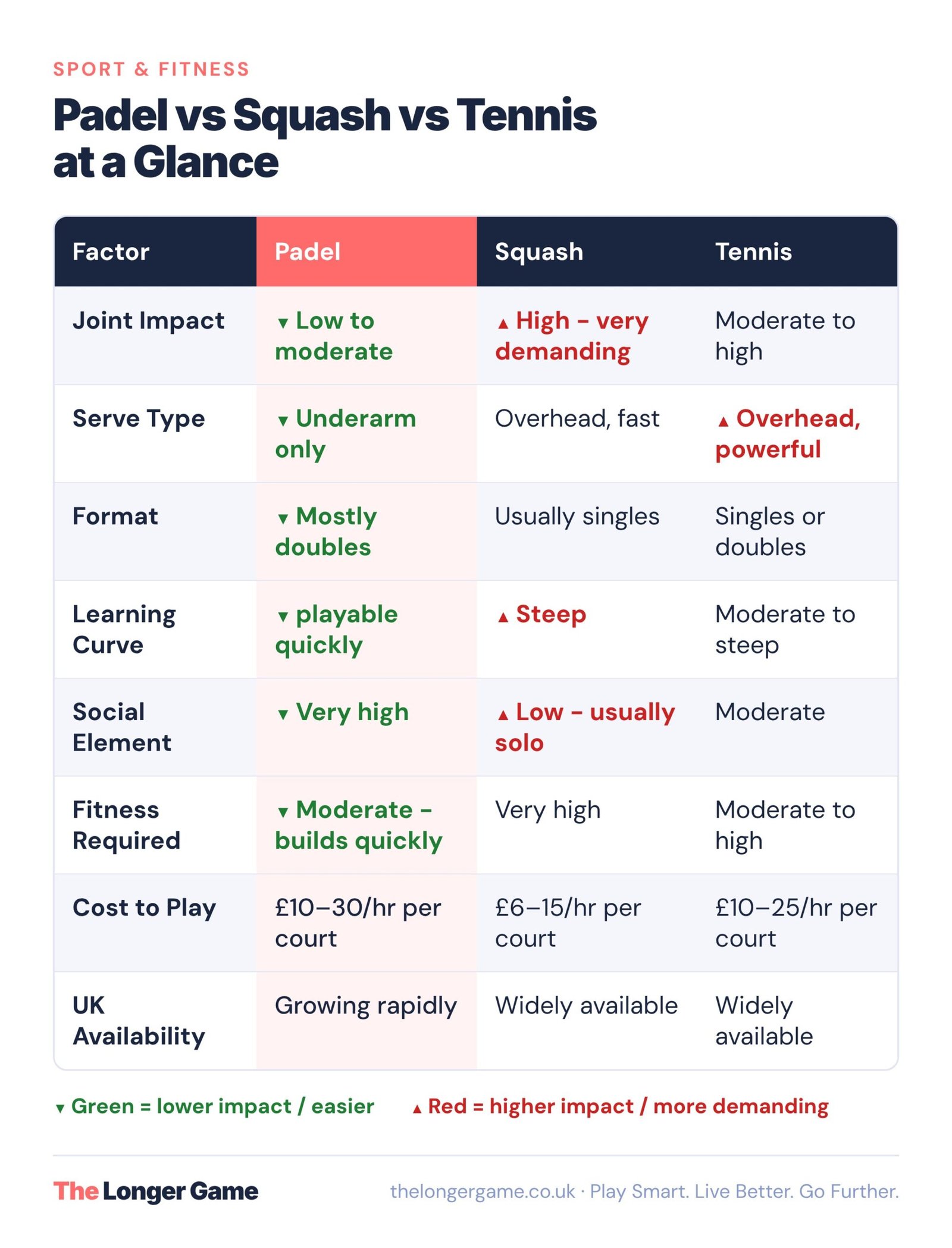
How It Compares: Padel vs Squash vs Tennis at a Glance
If you’re weighing up which sport makes sense for your body and your life at 40 +, this comparison should help you think it through:
Six Months In: What’s Changed
I’ve been playing padel 3 – 4 a week for 5 years. Some honest observations from someone who came to it specifically because their previous sport broke them:
The knees are a non-issue. I’ve had no long term joint discomfort after a padel game. Zero. Zilch. After years of managing squash around inflammation, this alone has changed my relationship with sport in a way that’s difficult to explain fully – unless you’ve been a hardcore squash player for 30+ years too.
The fitness is real. Padel looks deceptively relaxed from the outside. It is not. A competitive hour and a half with players of similar ability will push your heart rate considerably. After a month of twice-weekly sessions, I noticed a definite improvement in cardiovascular fitness and I was doing nothing else differently.
The technique has a way to go. I’ve improved consistently and I’m still nowhere near the ceiling of what the sport offers technically. The wall play in particular keeps revealing new complexity the better you get. This is a sport you can spend years getting better at, which matters if, like me, the competitive progression is a significant part of what you enjoy.
The social side has delivered exactly what I’d hoped. I play with three different sets of people, all of whom I’ve either met through the sport or reconnected with because of it. The doubles format builds a natural camaraderie, you need each other, you celebrate together and you usually end up in the bar afterwards reliving the same rallies as I used to do after squash. Some things don’t change. I’ve also started to enter tournaments and am meeting new playing partners and opponents and improving my Playtomic ranking!
What You’ll Need to Get Started
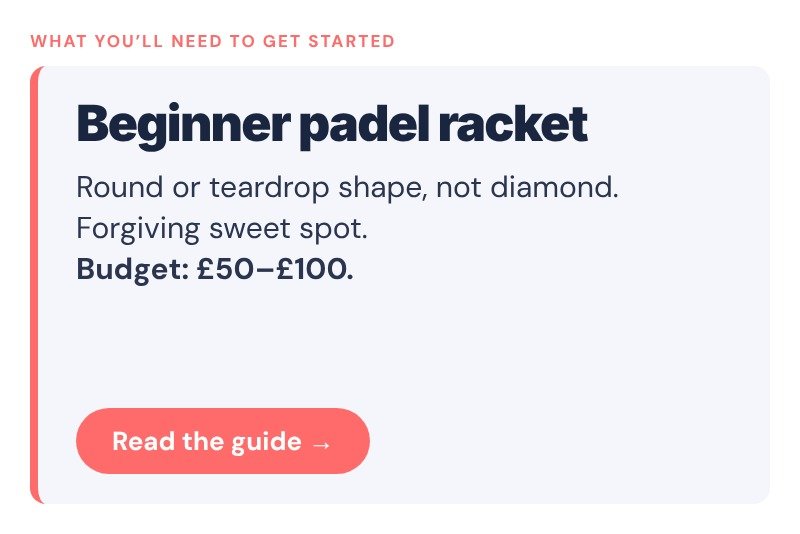
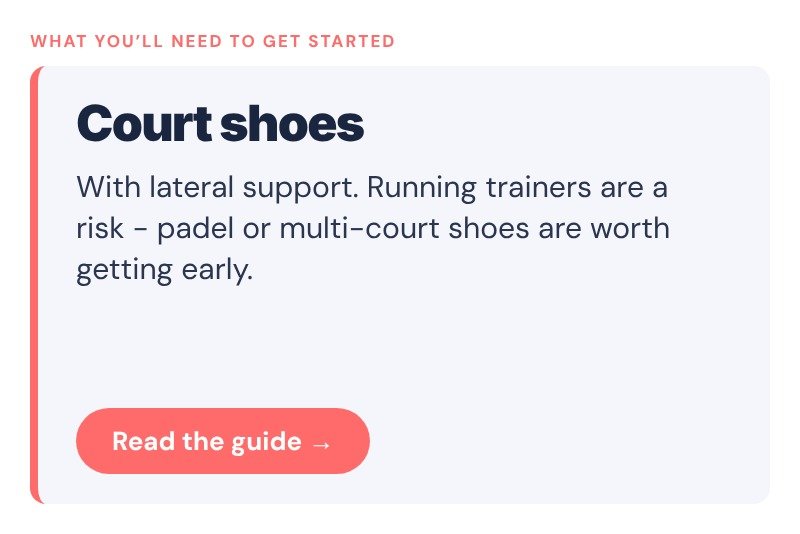
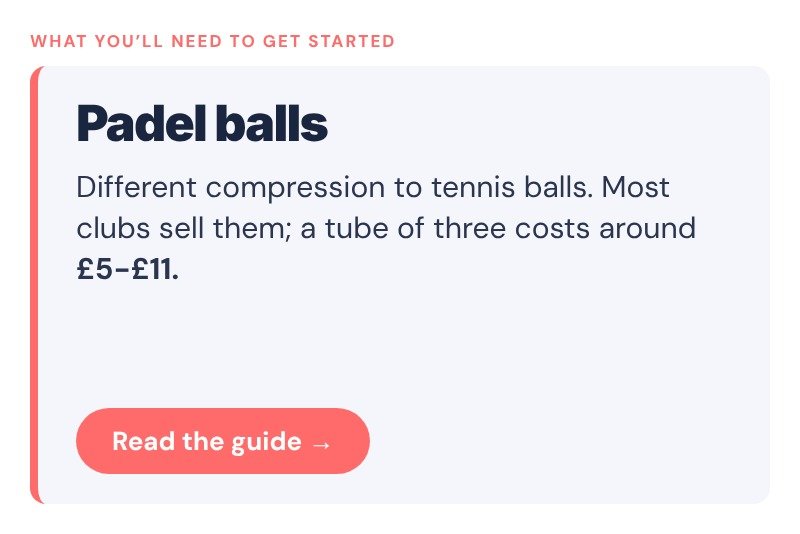
The good news: the barrier to entry is refreshingly low. Most padel clubs in the UK have loan/rental rackets for your first session or two, so you don’t need to invest in anything upfront. When you’re ready to get your own kit, here’s what actually matters:
One Thing I’d Tell Someone in My Position Three Years Ago
Don’t wait for the injury to force the decision. I spent two years playing through squash-related knee pain, trying different supports, different warm-up routines, different anti-inflammatories, trying recommendations from chiropractors, hoping things would settle down. They didn’t – they got progressively worse until stopping was no longer a choice.
If your body is starting to give you signals about a sport you’ve always played – if recovery is taking longer, if specific movements are generating specific pain, if you’re managing rather than playing, take those signals seriously earlier than I did. There are sports that will work with your body at 45, 50, and beyond. Padel is one of them. The goal is to keep moving, keep competing, keep having the social ritual that sport provides. The vehicle can change.
“The goal is to keep moving, keep competing. The vehicle can change.”
What Do I Think Now?
I’m playing more sport now, than I was at 43. I’m fitter than I was a year ago. My knees are fine. I’m getting better at something week by week. I have a whole new Whats App gang!
It took a slightly humbling first session, a few weeks of getting used to a very different serving style and a stack of borrowed rackets from a club in Hampshire.
Genuinely one of the better decisions I’ve made in life!
Frequently Asked Questions
Q: Is padel good for bad knees?
For many people with knee problems, padel is a gentler option than squash. The underarm serve, doubles format, enclosed court and shorter swing all reduce high-impact joint loading. After six months of playing twice a week, I have had no annoying knee discomfort. If you have an existing injury, check with a physio before you start.
Q: Is padel easier on your joints than squash?
In most cases, yes. Squash demands deep lunges, sudden changes of direction and fast, twisting swings and is usually played as singles. Padel is mostly doubles, so each player covers roughly half the court, the serve is underarm and the walls bring the ball back into play instead of you sprinting after it.
Q: Is padel better than tennis for your joints?
Padel removes the overhead serve, one of the most physically demanding movements in tennis for the lower back and shoulder. The court is smaller, play is usually doubles and the racket is a short, stringless paddle, so most players find padel lower impact than tennis while still competitive.
Q: Is padel a good sport to take up over 40?
Padel is one of the most accessible racket sports to start over 40. It is quick to pick up, very social and lower impact than squash or tennis. Most UK clubs rent/loan rackets for your first session or two, I’d highly recommend a lesson with a coach early on to help you learn to use the walls and avoid getting into bad habits.
Q: Is padel a good workout?
Yes. Padel looks relaxed from the outside, but a competitive 90 minutes against players of a similar level will push your heart rate considerably. After a month of playing twice a week, I noticed a improvement in my cardiovascular fitness without changing anything else.
Q; How much does it cost to play padel in the UK?
Court hire is typically £10 to £30 per hour per court, split between four players when you play doubles. A tube of three padel balls costs around £5 to £11 and a good beginner racket costs £50 to £100 when you are ready to buy your own.
Q: What do I need for my first padel session?
Very little. Most clubs lend or rent rackets and sell balls. The one thing worth sorting early is footwear: padel or multi-court shoes with lateral support are safer than running trainers, which are not designed for quick side-to-side movement.
FREE GUIDE — DOWNLOAD NOW
The Beginner’s Guide to Padel in the UK — courts, kit, rules and why everyone over 40 is talking about it.
Latest
Articles
Indoor Vs Outdoor Padel UK: Which Is Right For You?
Indoor courts give you consistent conditions all year. Outdoor courts are more accessible and cheaper to book. The right answer depends on when you play, what you wear and how seriously you want to take it.
I Quit Squash at 45 Because of my Knees – Why I Started Padel
A personal account of swapping a sport I loved for the one that loves my body back and why this might be the most important sporting decision I've made in twenty years.
How to Work Less in Three Years Without Blowing Up Your Career.
A practical roadmap for professionals who know the current pace and direction isn’t sustainable and is quietly working out what the alternative looks like. No fantasy, no silver bullets, just an honest plan.
A quick note on how we work: some of the links in our articles are affiliate links, which means if you buy something through them, we may earn a small commission at no extra cost to you. We only recommend gear and products we'd genuinely use ourselves, tested rather than guessed at. You can read more in our Affiliate Disclosure.